Choosing a website platform is one of the first decisions a small business owner has to make when building an online presence. It might seem like a straightforward choice at first, but the platform you select can affect how your website performs, how much it costs to maintain and how easily it can grow alongside your business.
A café might need a website with menus and online bookings. An electrician may want service pages that help customers find them on Google. An online retailer needs product listings, secure payments and a reliable checkout.
These businesses have different requirements, so choosing a platform simply because it is popular or inexpensive is not always the best approach.
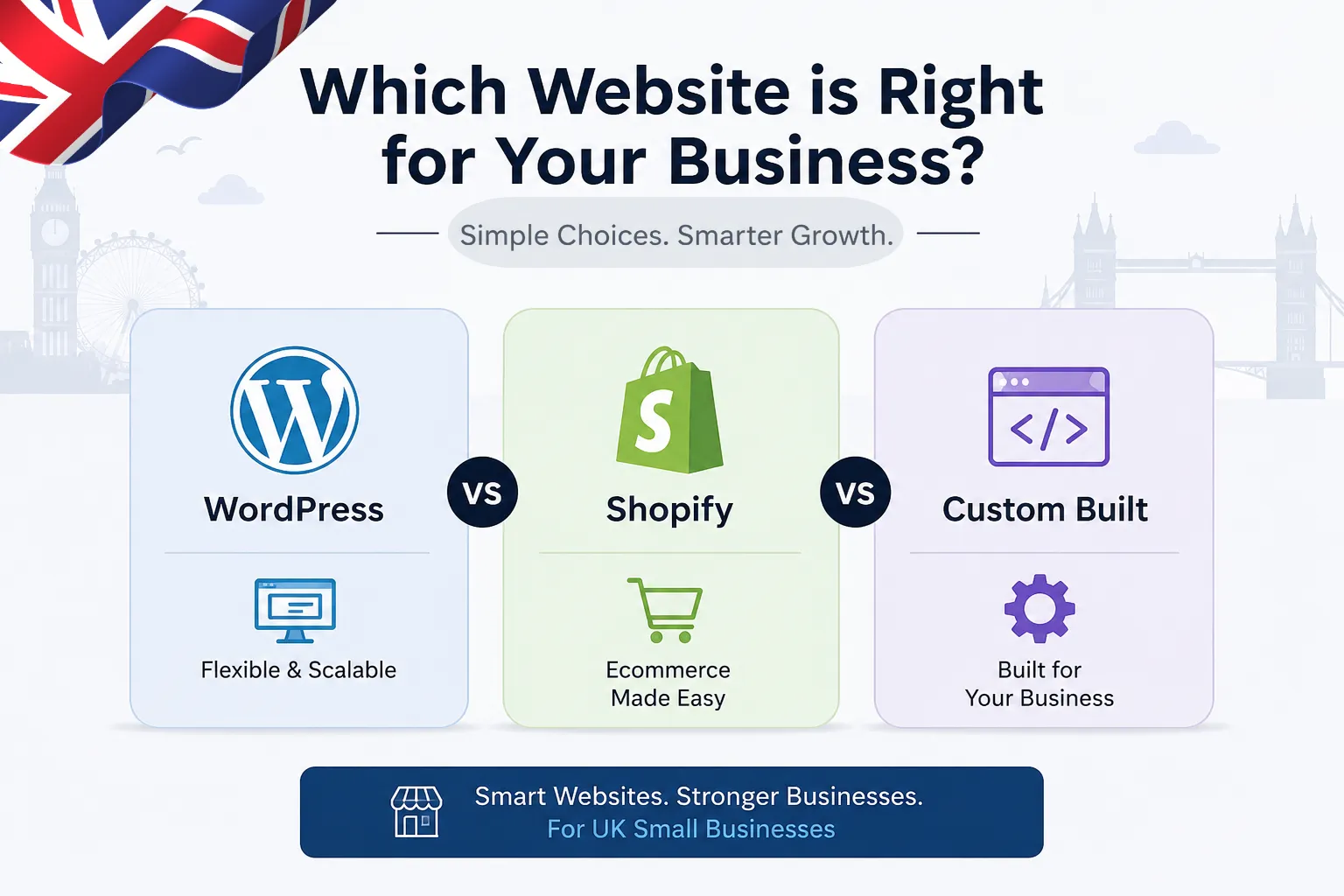
If you are wondering how to choose the right website platform for a small business in the UK, three options are worth considering: WordPress, Shopify and custom-built websites.
The short answer: WordPress is generally a good choice for service-based businesses, local companies and content-focused websites. Shopify is designed for businesses that primarily sell products online. A custom-built website is worth considering when your business needs specific features or functionality that standard platforms cannot easily provide.
A website platform is the software used to build, manage and update a website. Some platforms, such as Shopify, Wix and Squarespace, include hosting. WordPress is usually installed on hosting arranged separately, while a custom-built website is developed around the business's individual requirements.
Prices and fees in this guide were checked in November 2026. They may change, so check the provider's latest pricing before making a decision.
What Should You Consider Before Choosing a Website Platform?
Before comparing platforms, think about what you actually need your website to achieve.
Start with the main purpose of the website. Is it there to generate enquiries, sell products, showcase your work or allow customers to book appointments? A simple five-page business website has very different requirements from an online shop with hundreds of products.
You should also consider who will manage the website. If you want to update prices, publish blog posts and upload photographs yourself, choose a platform with a straightforward content management system.
Cost is another important factor. Look beyond introductory offers and compare hosting, subscriptions, transaction charges, plugins and maintenance over several years.
Website ownership matters too. Check whether you can access your website files, move to another hosting provider and work with a different developer if necessary.
Finally, consider how your business might develop. You may not need online payments today, but you might want to introduce them later. Choosing a flexible platform can save time and money when your requirements change.
WordPress: Flexible, Practical and Suitable for Growing Businesses
<escape>WordPress</escape> is a free, open-source content management system (CMS) that allows businesses to create and manage websites without paying a platform licence fee.
The self-hosted version, available through WordPress.org, gives website owners control over their hosting, content, design and website structure.
You normally pay for a domain name and hosting. Premium themes and plugins may involve additional costs, depending on the features you need. If you want to sell products, you can add WooCommerce to turn your website into an online shop.
One of WordPress's biggest advantages is flexibility. You can create service pages, publish articles, build landing pages and manage website content from one dashboard.
It also offers considerable SEO control. Website owners can manage page titles, meta descriptions, URLs, redirects, structured data and other technical elements.
There is a maintenance responsibility, however. WordPress, themes and plugins need regular updates. Backups and security also need attention. A poorly maintained website can develop compatibility problems or security vulnerabilities.
WordPress is suitable for: tradespeople, consultants, clinics, restaurants, local businesses, professional services, content-based websites and smaller online shops.
Businesses looking for a professionally developed WordPress website can explore our WordPress development service.
Shopify: Built for Businesses Selling Products Online
<escape>Shopify</escape> is a hosted ecommerce platform designed to help businesses sell products online without managing their own web hosting or server infrastructure.
Its subscription includes hosting, an SSL certificate, checkout facilities and essential ecommerce management features.
Businesses can manage products, stock, orders, delivery options, discount codes and customer information through the Shopify dashboard.
According to Shopify's UK pricing page, the published subscription prices in November 2026 are:
| PlanPaid monthlyPaid yearlyOnline card rate with Shopify PaymentsAdditional fee with another payment provider | ||||
| Basic | £25/month | £19/month | 2% + 25p | 2% |
| Grow | £65/month | £49/month | 1.7% + 25p | 1% |
| Advanced | £344/month | £259/month | 1.5% + 25p | 0.6% |
New stores may also qualify for a three-day free trial followed by an introductory offer of £1 per month for the first three months. Check the latest offer directly with Shopify.
Shopify is particularly useful for businesses that want to start selling without worrying about server maintenance or installing multiple ecommerce plugins.
However, subscription costs continue for as long as you use the platform. Some additional features require paid apps, which can increase monthly expenses.
There are also limitations around website structure and customisation. Product and collection URLs follow Shopify's established format, and certain checkout customisations require higher-tier plans.
Although products and customer information can be exported, moving the complete website to another platform requires additional work.
Shopify is suitable for: clothing brands, gift shops, electronics retailers, handmade product businesses and companies selling products across the UK.
Find out more about our Shopify web design services.
Custom-Built Websites: Designed Around Your Business Requirements
A custom-built website is developed specifically for a business rather than relying on a ready-made website platform.
Developers can use technologies and frameworks such as Laravel to create features that match the way a business operates.
For example, a recruitment company might need separate accounts for candidates and employers. A manufacturer could require customer-specific trade pricing. A booking company might need a system that checks staff availability, appointment lengths and available rooms.
These requirements can sometimes be handled using WordPress plugins or existing software. However, when several tools need to work together, a custom solution may provide better control.
The main consideration is the development cost. Custom-built websites generally require a larger initial investment than standard template-based websites.
You may also need a developer for future changes, depending on how the website has been designed.
Before choosing a custom development service, make sure you understand who owns the source code, whether you will receive access to the code repository and whether the project includes technical documentation.
Custom-built websites are suitable for: businesses with complex booking systems, customer portals, specialised ecommerce requirements, automated workflows and other business-specific functionality.
Explore our custom web development services.
A custom website is not necessary for every business. If you only need a few service pages, an about page and a contact form, WordPress may provide everything you need at a lower cost.
What About Wix, Squarespace and Other Website Builders?
Wix and Squarespace are popular website builders, particularly among individuals and small businesses creating their first website.
They offer ready-made templates and drag-and-drop editing tools. Hosting and security are generally included in their subscriptions, making them relatively straightforward to manage.
For a personal portfolio, a small business website or a basic online presence, these platforms can work well.
However, limitations can become noticeable as a business grows. You may have less flexibility with technical SEO, website structure and integrations compared with WordPress.
Moving a complete website to another hosting provider can also be difficult because the website is closely connected to the original platform.
For businesses planning to rely on organic search traffic or introduce more advanced functionality, WordPress or Shopify may provide greater flexibility.
WordPress vs Shopify vs Custom-Built: A Comparison
Each platform has different strengths. The following table compares their main features.
| FeatureWordPressShopifyCustom-Built | |||
| Best suited for | Service businesses, blogs and small shops | Online stores | Business-specific systems |
| Software cost | Free | £19–£259/month on yearly billing | Depends on development |
| Hosting | Purchased separately | Included | Purchased separately |
| Initial development cost | Low to medium | Low to medium | Usually higher |
| Payment fees | Set by payment provider | Depends on plan and provider | Set by payment provider |
| Maintenance | Owner or developer | Mainly handled by Shopify | Developer or maintenance team |
| Content management | Flexible | Easy to use | Depends on development |
| SEO control | Extensive | Good, with some structural limitations | Depends on implementation |
| Website ownership | High control | Platform-dependent | High control if code ownership is included |
| Moving to another provider | Yes | Data can be exported, but the site needs rebuilding | Yes, if code ownership is included |
| Typical development time | Weeks | Days to weeks | Weeks to months |
How Much Does a Small Business Website Cost in the UK?
Website costs vary depending on the platform, design, functionality and level of professional support required.
It is useful to separate website expenses into three categories.
Fixed Platform and Transaction Costs
Shopify publishes its subscription prices and payment processing charges. WordPress itself is free, while WooCommerce can be installed without a monthly platform subscription.
WooPayments, the payment solution for WooCommerce, does not charge a setup or monthly fee. Its published UK card processing rate is 1.5% + 25p per transaction.
You can check the latest charges on the WooPayments fees page.
Domain and Hosting Costs
A .co.uk domain may cost around £1 to £12 during an introductory first year, with renewal prices often around £10 to £15 annually before VAT. Actual prices depend on the registrar.
For a small WordPress website, hosting may cost approximately £5 to £30 per month, depending on the hosting provider and package.
Always check renewal charges, storage limits, backups and support before purchasing hosting.
Our guide to the best UK web hosting for small businesses explains the main points to consider.
Website Design and Development Costs
Professional website development costs depend on the number of pages, design requirements, integrations and functionality.
A basic DIY website may only require domain and subscription fees, although it will take your own time to build and maintain.
A professionally designed brochure website may cost from several hundred to a few thousand pounds. More complex custom-built websites can cost considerably more.
For a better understanding of your potential investment, use our website cost calculator or read our guide to how much a website costs in the UK.
What Does a Website Cost Per Month Once It Is Built?
The initial development cost is only part of the overall investment. You should also consider the monthly expenses involved in keeping your website online.
| Website typeTypical monthly running costWhat it includes | ||
| WordPress brochure website | Approximately £6–£30 | Hosting and domain cost averaged over the year |
| WooCommerce shop | Approximately £6–£30 plus transaction fees | Hosting, domain and payment processing |
| Shopify shop | £19–£25 plus transaction fees | Basic subscription and included hosting |
| Custom-built website | Varies | Hosting and any agreed support costs |
These are indicative figures, not fixed quotations. They exclude VAT, paid plugins, optional applications and professional maintenance.
WooCommerce vs Shopify Fees: A Worked Example
Consider an online shop generating £3,000 in monthly sales through 100 orders. Assume all payments are made using standard UK cards.
For Shopify Basic on annual billing:
- Monthly subscription: £19
- Percentage transaction fee at 2%: £60
- Fixed charge of 25p across 100 orders: £25
Total: £104 per month.
Now consider a WooCommerce website using WooPayments:
- Monthly subscription: £0
- Percentage transaction fee at 1.5%: £45
- Fixed charge of 25p across 100 orders: £25
Total: £70 per month, excluding hosting.
| Monthly expenseShopify BasicWooCommerce with WooPayments | ||
| Subscription | £19 | £0 |
| Card processing | £85 | £70 |
| Hosting | Included | £5–£30 estimated |
| Total before additional costs | £104 | £75–£100 |
WooPayments may also add 20% VAT to its fees unless a valid VAT number is provided. For a business unable to reclaim that VAT, the £70 processing cost becomes £84.
The example shows why it is important to compare the complete cost rather than looking at subscription prices alone.
For businesses considering either option, our ecommerce web design and WooCommerce development services provide further information.
Do Not Forget VAT
Many website development, hosting and platform prices are advertised before VAT.
If your business is not VAT-registered, you generally cannot reclaim VAT charged on eligible business purchases.
The VAT registration threshold is £90,000 in taxable turnover over a rolling 12-month period. You can read the latest details in the government's VAT registration guidance.
SEO: Which Website Platform Gives You More Control?
Search engine optimisation is an important consideration when choosing a website platform, particularly if your business depends on Google to attract new customers.
No platform automatically guarantees better rankings. Search performance depends on content quality, website structure, technical SEO, page speed, backlinks and how well your pages match what people are searching for.
WordPress offers extensive SEO flexibility. You can control page URLs, titles, descriptions, internal links, redirects and structured data.
Shopify also provides the essential SEO features needed by most online stores. You can edit product titles, descriptions and page metadata, while the platform generates an XML sitemap. However, its fixed URL structure gives you less control over certain elements.
A custom-built website can offer extensive SEO control, but technical features need to be included during development. XML sitemaps, canonical tags, redirects, structured data and editable metadata should all be considered from the beginning.
Whichever platform you choose, create useful pages for your services and products. Businesses serving local customers should also maintain an accurate Google Business Profile.
Search behaviour is also changing as people use AI-powered tools to find information. Clear, accurate content and well-structured website pages can help search engines and AI systems understand your business. Read more in our guide to AI search optimisation for UK businesses.
Website Speed, Mobile Usability, Security and Maintenance
A website should work properly on mobile devices, load without unnecessary delays and provide a straightforward experience for visitors.
Many customers browse websites on their phones, so mobile usability should be considered during the design and development process.
Website speed depends more on how a site is built and maintained than on the platform alone.
A WordPress website with lightweight design elements, suitable hosting and optimised images can perform well. However, excessive plugins, large images and poorly developed themes can affect loading times.
Shopify includes managed hosting, but installing too many third-party applications can still affect store performance.
Custom-built websites allow developers to optimise functionality around the actual requirements, although the result depends on the quality of development.
Security and maintenance should also be considered.
Shopify manages its hosting infrastructure and checkout security. WordPress and custom-built websites require appropriate updates, backups and security monitoring.
Businesses that do not want to manage these tasks themselves can use a professional website maintenance service.
There are also privacy requirements to consider. Websites using advertising or tracking technologies may need to obtain visitor consent before activating non-essential cookies. Check the latest ICO guidance on cookies and similar technologies to understand the requirements for your website.
Common Mistakes to Avoid When Choosing a Website Platform
Choosing a platform without considering the long-term requirements can create unnecessary costs and complications.
Choosing based only on the introductory price
A cheap first-month subscription does not tell you what the website will cost over the next few years. Include renewal prices, paid applications, hosting and transaction charges when comparing options.
Paying for features you do not need
A small service business does not necessarily need an advanced ecommerce platform or complicated custom functionality. Start with the features that support your actual business activities.
Ignoring website ownership
Your business should have control over its domain name and important website accounts. Make sure you have access to hosting, website administration and relevant files.
Installing too many plugins and applications
Every additional plugin or application can introduce another cost, update requirement or compatibility issue. Use only the tools your website genuinely needs.
Not considering future changes
Your business may introduce new services, locations or products. Choose a platform that can accommodate realistic changes without requiring a complete rebuild.
Assuming a website is finished after launch
Websites need ongoing attention. Content updates, security checks, backups and performance monitoring all contribute to keeping a website useful and reliable.
Our article on first website mistakes made by UK startups covers other issues worth understanding before launching a new website.
How to Choose the Right Platform for Your Business
The best way to narrow down your options is to start with the main purpose of your website.
Consider these four questions:
- Will you mainly sell products online? Shopify is a practical starting point for businesses that need product management, stock control, secure checkout and delivery options.
- Does your website need specialised functionality? If you need customer portals, complex booking systems, automated quotations or business-specific workflows, consider custom development.
- Do you mainly want to attract enquiries through Google? WordPress is often a suitable option for businesses that need service pages, location pages, blogs and flexible SEO management.
- Are you still unsure? Compare the total cost, editing experience, ownership and maintenance requirements before making a decision.
Here are some examples of how different UK businesses might approach the choice.
| BusinessMain website requirementsSuitable platform | ||
| Plumber covering Derby and nearby towns | Service pages, local SEO, reviews and enquiry forms | WordPress |
| Handmade candle business selling nationwide | Product listings, stock management and checkout | Shopify |
| Recruitment agency | Job listings, candidate accounts and CV uploads | Custom-built |
| Café selling coffee and accepting bookings | Menu, opening hours, table bookings and a small shop | WordPress with WooCommerce |
The right platform is the one that meets your current requirements without creating unnecessary complications as the business develops.
Frequently Asked Questions
What Is the Best Website Platform for a Small Business in the UK?
WordPress is a suitable choice for most service-based businesses that need an online presence, content management and local SEO. Shopify is generally better for businesses primarily selling products online. Custom-built websites are more appropriate when specialised functionality is required.
How Much Does a Small Business Website Cost Per Month in the UK?
A basic WordPress website may cost approximately £6–£30 per month for hosting and domain expenses. A Shopify Basic subscription costs £19 per month on annual billing or £25 when paid monthly, excluding transaction fees and optional applications. Professional maintenance and additional services may increase the overall cost.
Is WordPress or Shopify Cheaper for a UK Small Business?
WordPress is generally less expensive for a standard business website because there is no monthly platform subscription. For online shops, the overall cost depends on sales volume, hosting, payment processing and additional applications. WooCommerce can have lower platform costs, while Shopify includes managed hosting and ecommerce infrastructure.
Can I Build My Business Website Myself?
Yes. WordPress and Shopify both allow business owners to create websites without writing code. Website builders such as Wix and Squarespace also offer templates and drag-and-drop editing. However, professional development may be useful when you need a more individual design, advanced functionality or technical SEO setup.
Do I Need a Custom-Built Website?
Not necessarily. Most small businesses can operate effectively with WordPress or Shopify. Custom development becomes useful when standard platforms cannot handle your business requirements efficiently. This could include complex booking systems, customer portals or specialised integrations.
Can I Switch Website Platforms Later?
Yes, but moving between platforms requires planning. Website content, product information and customer records can often be exported, but the design and functionality may need to be rebuilt. Existing URLs should also be redirected correctly to protect organic search traffic. A properly planned website migration can help reduce disruption.
Which Website Platform Is Best for SEO?
WordPress offers extensive control over technical SEO, content structure, URLs and metadata. Shopify provides the main SEO features required by most ecommerce businesses. Custom-built websites can offer similar flexibility, provided the relevant SEO features are included during development.
Should I Buy My Domain Through My Website Platform?
You can purchase a domain through Shopify or another platform, but registering it separately in your business's name can make ownership and future transfers easier. Make sure your business controls the domain account and renewal details.
Is WooCommerce Cheaper Than Shopify?
WooCommerce does not charge a monthly platform subscription, while Shopify requires a paid subscription. WooPayments has a published UK card processing rate of 1.5% + 25p. Shopify Basic has a standard UK card rate of 2% + 25p when using Shopify Payments. However, WooCommerce also requires hosting and ongoing maintenance, so the overall cost depends on your requirements.
Is Wix or Squarespace Good Enough for a Small Business?
Yes. Both platforms can work well for simple websites, portfolios and businesses that want an easy way to manage their online presence. However, WordPress may be more suitable when you need greater flexibility with SEO, integrations and website ownership.
How Long Does It Take to Build a Small Business Website?
A simple website created using a template may be ready within a few days. A professionally developed WordPress website generally takes a few weeks, while a custom-built website can take several weeks or months depending on its complexity. Content preparation, design approval and the number of required features also affect the timeline.
Do I Need a Cookie Banner on a UK Website?
If your website uses non-essential cookies or tracking technologies, you generally need to obtain the required visitor consent before activating them. Some limited statistical uses may qualify for exemptions under the updated rules introduced in 2026. Check the latest ICO guidance to understand how the requirements apply to your website.
Final Thoughts
There is no single website platform that works for every small business in the UK. The right choice depends on what you want your website to achieve, how you plan to manage it and what you expect it to cost over time.
WordPress offers flexibility for service businesses and content-led websites. Shopify provides an established ecommerce system for businesses selling products online. Custom development gives businesses more control when they need functionality beyond standard platforms.
Before making a decision, compare the complete running costs, check website ownership arrangements and consider how easily the platform can support future changes.
If you are planning a new website or considering moving from an existing platform, contact WebGenix to discuss your requirements and find a suitable approach for your business.


Comments (0)
No comments yet. Be the first to share your thoughts!